
Jaipur to Ayodhya Ram Mandir Group Bus Rental: Cost, Route & Days Needed
November, 2026
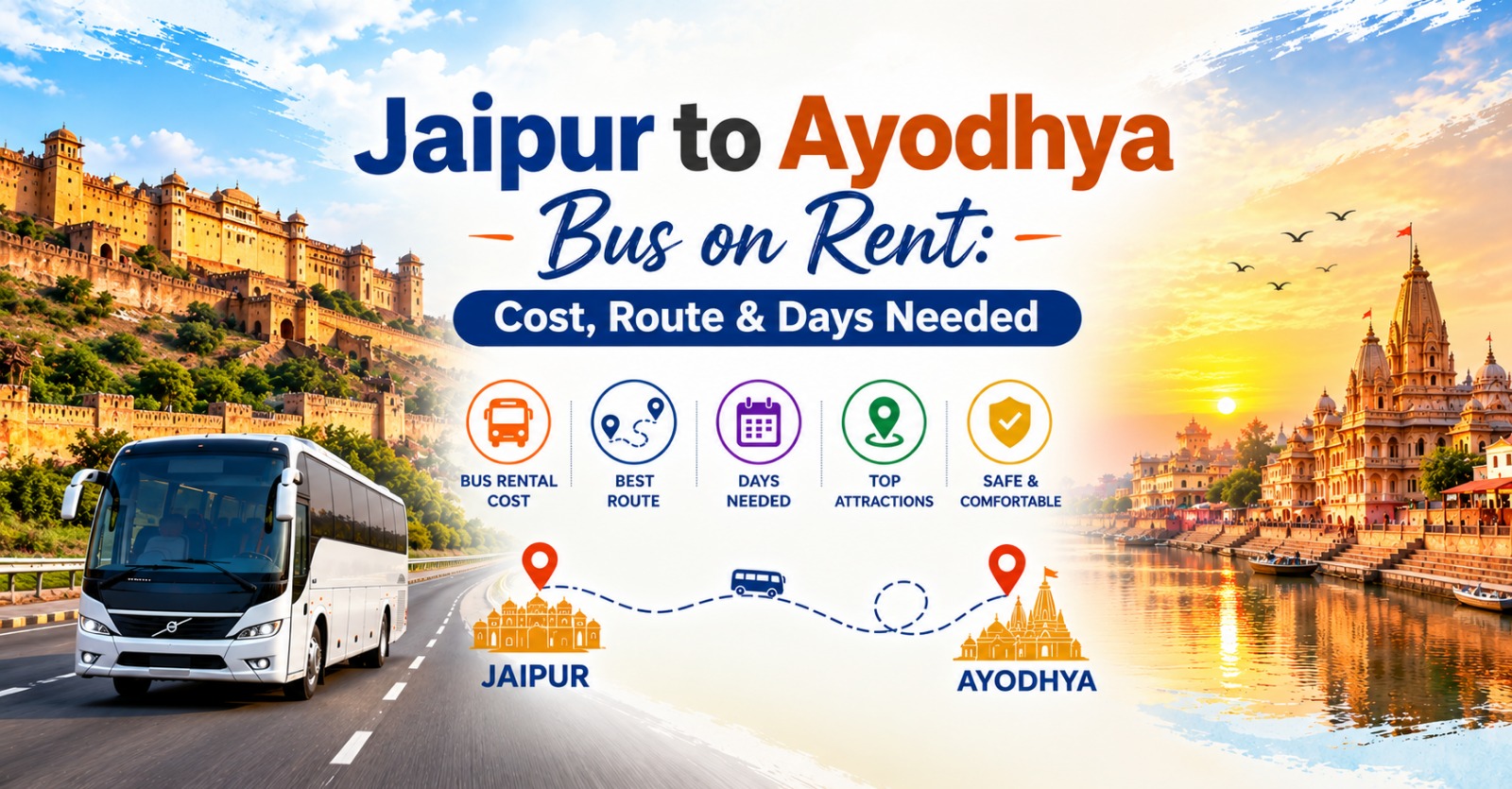
Jaipur to Ayodhya Ram Mandir Group Bus Rental: Cost, Route & Days Needed
Every year, plenty of families in Jaipur say the same thing: “Chalo, sab milke Ayodhya chalte hain.” Then the real planning starts. Forty people, different ages, one train with no confirmed seats, and nobody wants to be split up. That is usually the moment a private bus starts to make sense.
If you are looking at a Jaipur to Ayodhya bus on rent, this guide will help you sort out the distance, the likely cost, how many days to keep aside, and what else you can see besides the Ram Mandir. The prices below are rough market figures. Use them to plan and get the final number in writing before you pay anything.
Everything You Need to Know Before Booking
Distance: around 700 km one way. Different maps show anything from 690 to 735 km, depending on where you start in Jaipur.
Time on the road: 12 to 14 hours one way with stops.
Best bus for 40 to 49 people: a 49-seater AC Volvo coach.
Rough rent: Rs 55 to Rs 65 per km. For a 4-day trip of about 1,500 km, that is roughly Rs 82,500 to Rs 97,500.
Usually charged extra: driver allowance, toll, parking, and state permit.
Days needed: 3 at the very least, 4 if you want to be comfortable, 5 or 6 if you add Lucknow, Prayagraj or Varanasi.
Why Families and Groups Prefer a Private Bus
Think about how a normal trip goes. You book train tickets, and half the family gets a confirmed seat while the rest wait on the list. Or you buy sleeper bus tickets, and everyone ends up in different berths, some of them far from the older members.
A private coach removes all that. Everyone sits together, the luggage goes in one place, and the pooja samagri does not get lost. If someone needs a break, the bus stops. If the evening aarti runs late, the bus waits.
An Ayodhya group tour bus also gives you control over the schedule. You pick the departure time, you pick where to eat, and you decide when to start back. For a mandali or a society trip, that freedom matters more than people expect.
The money works out better than it looks. Divide the bus rent across 40 to 45 people, and it comes to around Rs 1,800 to Rs 2,200 each for a round trip. That is close to what many people pay for individual tickets, and you get a lot more comfort for it.
Jaipur to Ayodhya Distance and Route
Most buses go from Jaipur to Agra through Dausa and Bharatpur. From Agra, they take the Agra-Lucknow Expressway. Then it is Lucknow to Ayodhya, either on the regular highway or on the Purvanchal Expressway.
| Route Segment | Approx Distance | Approx. Time by Bus |
|---|---|---|
| Jaipur to Agra | 240 km | 4 to 5 hours |
| Agra to Lucknow (Expressway) | 300 km | 4 to 5 hours |
| Lucknow to Ayodhya | 135 km | 2.5 to 3 hours |
| Total one way | About 700 km | 12 to 14 hours with stops |
Not everyone starts from Jaipur, of course. If your group is coming from another Rajasthan town, the distance changes.
| Pickup City | Approx. Road Distance to Ayodhya |
|---|---|
| Alwar | 615 km |
| Kotputli | 670 km |
| Jaipur | 700 to 735 km |
| Sikar | 820 km |
| Ajmer | 825 to 870 km |
| Jodhpur | 1,010 km |
You will cross a few toll plazas on the way, so ask the operator if FASTag charges are already in the quote. Also keep some buffer time. Fog in winter and heavy rain in the monsoon can slow the expressway more than you would think.
Which Bus Should You Pick
Size matters on a trip this long. Too big, and you pay for empty seats. Too small, and 13 hours feels very long. We run only Volvo coaches, so the choice comes down to three options for your group.
| Group Size | Suitable Volvo Bus |
|---|---|
| Up to 40 people | 45 Seater Volvo Bus |
| 40 to 49 people | 49 Seater Volvo Bus |
| Groups that want the extra comfort of a premium coach | Volvo 9600 Bus |
| 50 or more people | Two Volvo buses, so everyone gets a proper seat |
45 Seater Volvo Bus Rental Jaipur
Best for groups of 30 to 40 people. You get a few spare seats for bags and prasad, and the bus feels roomy for a long overnight drive. It suits family groups, temple committees, and small mandalis.
49 Seater Volvo Bus Rental Jaipur
Best when you have 40 to 45 travellers and want every person to have a seat with room left over, or when your group is close to full capacity. It is the usual pick for society trips and larger family groups.
Volvo 9600 Bus Rental in Jaipur
Best for groups who want a premium long-distance coach for a 700 km journey, such as senior citizens or families travelling with children. Share your travel dates and group size, and we will confirm the seating layout and features available for your trip.
What Will It Cost
Long-distance buses are charged per kilometre. For a 49-seater AC coach, the going rate is roughly Rs 55 to Rs 65 per km, plus a driver allowance of about Rs 1,200 to Rs 1,500 per day. Most operators set a minimum of 300 to 350 km a day. A one-way drop is often billed as a round trip too, since the bus has to come back empty.
| Trip Plan | Approx Total Km | Estimated Bus Rent (Rs 55 to Rs 65/km) | Driver Allowance (approx) |
|---|---|---|---|
| 3 days, quick darshan | 1,450 km | Rs 79,750 to Rs 94,250 | Rs 3,600 to Rs 4,500 |
| 4 days, recommended | 1,500 km | Rs 82,500 to Rs 97,500 | Rs 4,800 to Rs 6,000 |
| 6 days, Ayodhya plus Prayagraj | 1,900 km | Rs 1,04,500 to Rs 1,23,500 | Rs 7,200 to Rs 9,000 |
For a full bus of 45 people, the rent alone comes to around Rs 1,800 to Rs 2,200 each on the 4-day plan, and Rs 2,300 to Rs 2,750 each on the 6-day plan.
Normally included: the bus, AC, driver, fuel, and basic insurance.
Normally extra: driver allowance, toll, parking, state tax or permit, night halt charges and any kilometres beyond the plan.
These numbers move with the season, the type of bus, and your pickup point. So ask for an itemised quote and compare it line by line.
A few ways to save money:
- Travel on weekdays and avoid festival weeks.
- Fix your stops in advance so you do not add extra kilometres.
- Book two to three weeks ahead.
- Give the operator your exact headcount so the right bus is confirmed.
How Many Days Should You Plan
Three days is possible but tight. You will spend two nights on the road and have just one day for darshan. It suits younger groups who do not mind being tired.
Four days is what most families choose. You get one proper night’s rest in Ayodhya and enough time to see the main temples without rushing.
Five or six days make sense for senior groups, or if you want to add Lucknow, Prayagraj, or Varanasi.
Here is a simple 4-day plan that works for most groups.
Day 1: Leave Jaipur in the afternoon or evening and travel overnight through Agra and Lucknow. Plan stops for dinner and a short rest.
Day 2: Reach Ayodhya in the morning, check in, and freshen up. Start with Hanuman Garhi, then go for Ram Mandir darshan in your slot, and visit Kanak Bhawan after that. Finish the day with the Saryu aarti near Ram Ki Paidi.
Day 3: Cover Dashrath Mahal, Treta Ke Thakur, Nageshwarnath Temple and Guptar Ghat. If there is time, add Bharat Kund. Pick up prasad and souvenirs, then start back in the evening.
Day 4: Reach Jaipur by morning or early afternoon.
If there are many senior citizens, add one more night in Ayodhya and spread the temples over two days. Darshan timings and entry rules can change, so check the official Shri Ram Janmabhoomi Teerth Kshetra website before you lock the plan.
Famous Places to Visit Along With Ram Mandir
The good news is that most of Ayodhya’s big temples are a few kilometres apart. One bus base is enough. Just keep in mind that large buses usually cannot go right up to the temple because of crowd control. You will park at a designated spot and take e-rickshaws or walk the last stretch.
| Place | Approx. Distance from Ram Mandir | Why Visit |
|---|---|---|
| Hanuman Garhi | 1 km | Usually visited before Ram Mandir, a hilltop temple with a flight of steps |
| Dashrath Mahal | Very close to Hanuman Garhi | Believed to be Lord Ram’s family palace |
| Nageshwarnath Temple | 1.2 km | One of the oldest Shiva temples in the city |
| Kanak Bhawan | 1.5 km | Golden temple dedicated to Ram and Sita |
| Treta Ke Thakur | 2 km | Known for its old black stone idols |
| Ram Ki Paidi and Saryu Ghat | 3 km | Holy dip and the evening aarti |
| Guptar Ghat | 6 to 10 km | A quiet riverside spot linked to Lord Ram’s departure |
| Bharat Kund | 15 to 20 km | Linked to Bharat’s stay during Ram’s exile |
Tulsi Smarak Bhawan, Mani Parvat, and Sita Ki Rasoi are also worth a short stop if you have time.
Want to stretch the trip? Lucknow is about 135 km from Ayodhya and falls right on your route, so it is easy to add for a night halt or a short city tour. Prayagraj, home of the Triveni Sangam, is around 165 km away, and Varanasi is about 220 km. Naimisharanya, an old pilgrimage town roughly 90 km from Lucknow, can be a stop on the way. Each add-on means more kilometres and probably one more day, so decide before you ask for the quote.
Best Time to Go
October to March is the comfortable season. The weather is mild, which helps a lot when you are walking between temples all day. Around Ram Navami, Diwali, and Kartik Purnima, the crowds are huge, so book the bus, the stay, and your darshan plan early. April to June is hot and hard on older travellers. In December and January, thick fog can make early morning driving risky, so avoid very early starts on foggy days.
Small Things That Make the Trip Smoother
Good planning of a Ram Mandir yatra bus trip comes down to small details.
- Carry a valid photo ID for every passenger. It is often needed for darshan and hotel check-in.
- Choose one group leader and keep a printed passenger list.
- Share the driver’s number and the bus number with every family.
- Pack light. Keep medicines, water, and snacks in hand luggage.
- Ask for a second driver, or plan a proper night halt for safety.
- Keep some cash for parking, e-rickshaws, and offerings.
- Reach the pickup point 15 minutes early.
How to Book
- Send your travel dates, group size, pickup point, and number of days.
- Get an itemised quote with the bus type and per-km rate.
- Confirm with a small advance.
- Receive the bus and driver details a day before departure.
- Board on time and enjoy the yatra.
Final thoughts
A Ram Mandir yatra from Jaipur is a long drive, but it does not have to be a hard one. Pick a bus that fits your group, keep three to four days for the trip, and add Hanuman Garhi, Kanak Bhawan, and the Saryu ghats to the main darshan. That is usually all it takes to make the journey easy for everyone, from kids to grandparents.
Ready to book Jaipur to Ayodhya bus on rent for your group? Call or WhatsApp us at the number given on this page and share your travel date, group size, and pickup point. We will send you a clear quote for a 49-seater AC Volvo coach. Seats go fast around festivals, so do not wait too long. Get your free quote today and plan your next Ayodhya group tour bus trip without the stress.
Get a Quote for Volvo Bus Booking in Jaipur
Frequently Asked Questions (FAQs)
Contact Us
Have a question or need assistance? Fill out the form below. Our team will get back to you shortly.